How to start a restaurant business in Dubai in 2026: 12 steps to keep you on track
How to start a restaurant business in Dubai in 2026: 12 steps to keep you on track
Vincy Amirtharaj
58 post
Senior Business Setup Consultant, Dubai
If you are planning to start a restaurant business in Dubai, the city offers one of the most dynamic culinary landscapes in the world. The city is growing as a global culinary capital, second only to Paris in 2024, according to the third annual Gastronomy Industry Report issued by the Dubai Department of Economy and Tourism. The market shows promising growth as about 2,336 new food establishments were launched in the first half of 2025 alone. Plus, around 1,200 new restaurant licenses were issued in 2024 ranging across different cuisines. All of this strengthens the strategic role of the city as a global food trade gateway.
Dubai features a diverse population and a stable tourism scene, creating an excellent atmosphere for restaurant businesses from fine dining to fast food chains. We will guide you to choose concepts, location and necessary steps regarding licensing, permits, staffing, etc.
Typical 8-week restaurant-setup timeline
Week
Authority / Task
Key output
1
DET or Free Zone
Initial approval ✓ | Trade-name reservation ✓
2
Dubai Municipality (Food Safety Department)
Initial food business registration ✓
3
Dubai Land Department / Ejari
Restaurant premises lease → Ejari uploaded
4
Dubai Municipality (Planning)
Floor-plan & kitchen-layout approval ✓
5
Civil Defence
Fire-safety compliance certificate issued ✓
6
DET or Free Zone
Restaurant commercial licence issued ✓
7
Dubai Municipality (Food Safety)
Food-handler health cards & PIC training completed ✓
8
Bank & FTA
Corporate bank account + VAT TRN — Go live!
Note: Free-zone “express” packages can compress Weeks 1-4 into ~10 days; banking KYC or high-risk nationalities may extend Week 8.
“Dubai’s food and restaurant sector is a key pillar of the emirate’s tourism strategy and ambitious vision, and its continued growth reflects the wise leadership’s vision to achieve the objectives of the Dubai Economic Agenda D33, which aims to make the emirate the best city in the world to live, work and visit.”
- Ahmed Al Khaja, CEO of Dubai Festivals and Retail Establishment
Step 1: Choose a concept for your restaurant business
Choose from cafes, fine-dining restaurants, fast-food shops, food trucks and catering services.
Cuisine
Pick an area of cuisine or theme. For example, Emirati, Arabic, Indian, Italian, Japanese or fusion.
Customer target
Identify who you want to serve, such as tourists, local residents, corporate clients and delivery customers.
Service approach
Decide if you will offer dine-in, takeaway, delivery or a combination of these.
Pro tip
Dubai Food Code must be followed for all food businesses in Dubai and requires approval from Dubai Municipality’s Food Safety Department.
Step 2: Select a trade name for your restaurant
UAE trade name rules must be taken into consideration before naming your restaurant. The name shouldn’t be offensive or misleading. The words must not have religious or political undertones. Identifiers are required for some structures (eg. LLC). Make sure of domain availability by securing a website and branded email.
Step 3: Create a restaurant business plan
Create a business plan with a well-organized and structured outline of your restaurant concept to the authorities and banks. You can begin with an executive summary explaining the concept, key menu elements, operational processes, sourcing strategy, suppliers and kitchen layout. Include the proper DET activity codes for all restaurant types, cafes, catering companies or cloud kitchens. The business plan should also cover your location choices, market positioning and your staffing and visa needs for chefs, servers and managers.
In addition, the business plan should contain a detailed financial analysis including initial investment costs, rent, salaries, running expenses, food cost percentages and expected profit margins. Finally, you need to detail your compliance process including food safety regulations, HACCP compliance, VAT obligations and corporate tax obligations.
Pro tip
A strong social media presence is essential for the market strategy as the data from the Dubai Department of Economy and Tourism testifies that around 70% of restaurant-goers in the UAE seek recommendations from social media before choosing a restaurant to visit.
Restaurant-setup cost estimator (AED)
Estimated setup cost: —
Get detailed breakdown on WhatsApp
*Includes AED 1 070 for initial approval (150) + trade-name reservation (920).
Fit-out, rent, food-safety permits & bank guarantees vary—chat with us for an exact quote.
Step 4: Select a business structure
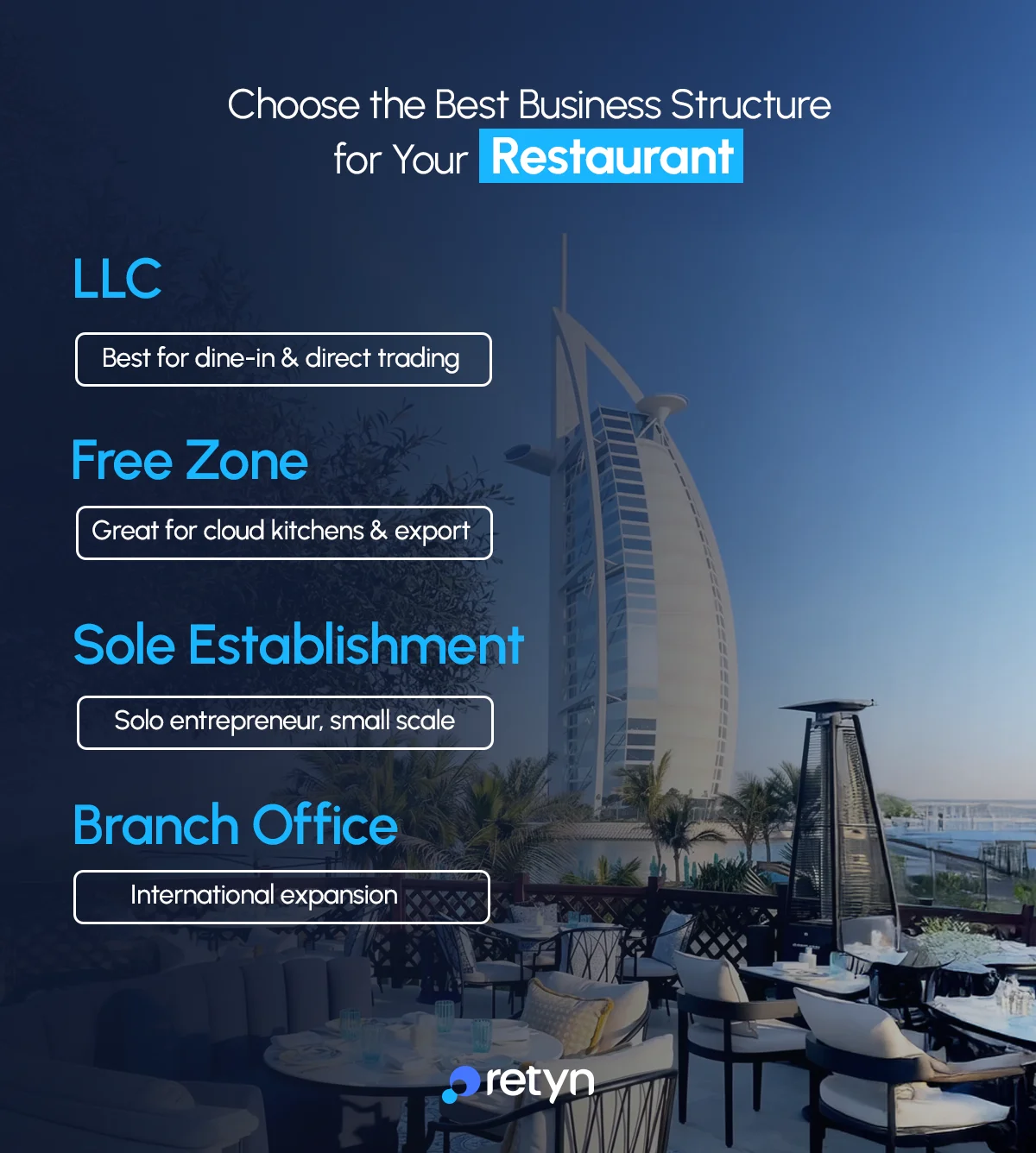
Popular business structures for restaurants in Dubai includes the following.
LLC (Limited Liability Company, Mainland)
It is the most common for dine-in restaurants, cafes and catering. Direct trading in Dubai, limited liability protection and access to government tenders are also eligible here.
Free Zone FZ-LLC/FZE
Additional permissions are needed for onshore sales. Perfect for cloud kitchens, food export/import and delivery-only concepts.
Sole Establishment
Suitable for individual food entrepreneurs and small cafes. Risk management is vital as the owner has unlimited liability.
Branch Office
Mostly limited to the core activities of the parent company. It is ideal for an international restaurant chain expanding into Dubai.
Quick fact
Dubai Municipality is taking steps to strengthen food quality and safety standards, as data from the first half of 2025 highlighting food safety and inspection efforts. A total of 34,700 inspection visits were conducted throughout the Emirate across food establishments.
Step 5: Choose your jurisdiction: Mainland vs free zone
UAE offers two main jurisdictions for setting up a restaurant business; they are mainland and free zone.
MainlandMainland (Dubai Department of Economy and Tourism - DET)
Mainland company formation in Dubai is the right option for businesses that directly serve customers like restaurants, cafes and catering services. It requires physical location (Ejari contract).
Free zones (DMCC, IFZA, Meydan, DAFZA)
Free zone company formation in Dubai are apt for food trading, delivery-only models and cloud kitchens. Onshore sales or dine-in operations require additional approvals or dual licensing.
Ready to launch your restaurant in Dubai?
Visit our restaurant business setup page to explore how our team helps with licensing, approvals and complete setup support to get operational faster.
Secure initial approval and reserve your business trade name with the DET.
Choose an activity code based on service type. This can be restaurants, cafes, catering services, food trucks or cloud kitchen.
Lease your restaurant premises. Mainland setups require an Ejari-registered space, while free zone businesses need to lease a facility that is approved by the respective Free Zone authority.
Submit constitutional or legal documents (like the MoA) of your company.
Obtain external approvals from the Dubai Municipality’s Food Safety Department.
Receive your license and establishment card after completing these steps.
Pro tip:
Get your kitchen layout approved by Dubai Municipality before starting any fit-out work to avoid delays.
Licence-application document checklist
Mainland LLC / Sole Establishment
Passport & UAE entry stamp (all shareholders)
Emirates ID or UID number
Restaurant-space lease / Ejari certificate
Dubai Municipality Food Safety pre-approval letter
Civil Defence fire-safety clearance
HACCP-compliant kitchen layout & food-safety plan
No-objection certificate (if on existing visa)
Initial approval & trade-name certificates
Free zone (e.g., DSO, DMCC)
Passport copy (all shareholders)
Visa / entry stamp or last visit date
Shareholder CV + photo
Restaurant premises lease agreement
Food-activity code selection form
Dubai Municipality Food Safety permit (FoodWatch)
Proof of address (utility bill or bank statement)
Tip: Scan PDFs at 300 dpi to avoid portal re-uploads. Keep originals for bank KYC, Civil Defence & Food Safety inspections.
sequenceDiagram
participant Founder
participant DED as DED / Free Zone
participant DM as Dubai Municipality (Food Safety)
participant CD as Civil Defence
participant Bank
participant GDRFA
participant Insurer
Founder->>Founder: 1 · Choose cuisine & concept
Founder->>DED: 2 · Reserve trade name
Founder->>Founder: 3 · Draft business plan
Founder->>Founder: 4 · Select structure
Founder->>Founder: 5 · Lease premises & register Ejari
Founder->>DED: 6 · Apply for restaurant licence
DED-->>Founder: Licence issued
Founder->>DM: 6a · Submit kitchen layout & HACCP plan
DM-->>Founder: Food Safety approval issued
Founder->>CD: 6b · Apply for fire-safety clearance
CD-->>Founder: Clearance granted
Founder->>GDRFA: 7 · Immigration & visas
GDRFA-->>Founder: Visas stamped
Founder->>Bank: 8 · Open bank account
Bank-->>Founder: Account approved
Founder->>Insurer: 9 · Public-liability & restaurant insurance
Insurer-->>Founder: Policy issued
Note over Founder: 10 · Renewals (licence · food-safety · fire-safety · VAT)
Step 7: Set up immigration and labor files; plan visas
You are required to create both an immigration file and labor file for staff once you receive your license approval to operate a business in Dubai. There are several steps involved in Visa processing in Dubai including obtaining investor visas and having all employee medical tests completed. In addition to these requirements, you will also be responsible for arranging health insurance for employees and acquiring a certificate of compliance from Dubai's Food Safety Department after the kitchen staff have successfully completed their food handler training program. You are also required to comply with the Mandatory Wage Protection System (WPS).
Step 8: Open a corporate bank account
Use corporate banking assistance in Dubai to improve your account opening process, including gathering and submitting the appropriate documentation. This will require an extensive business profile with market analysis and cash flow projections, as well as shareholder and UBO (Ultimate Beneficial Owner) information, draft menus, supplier agreements, etc. You will also need to acquire a branded email address and website to meet the compliance checks that banks carry out.
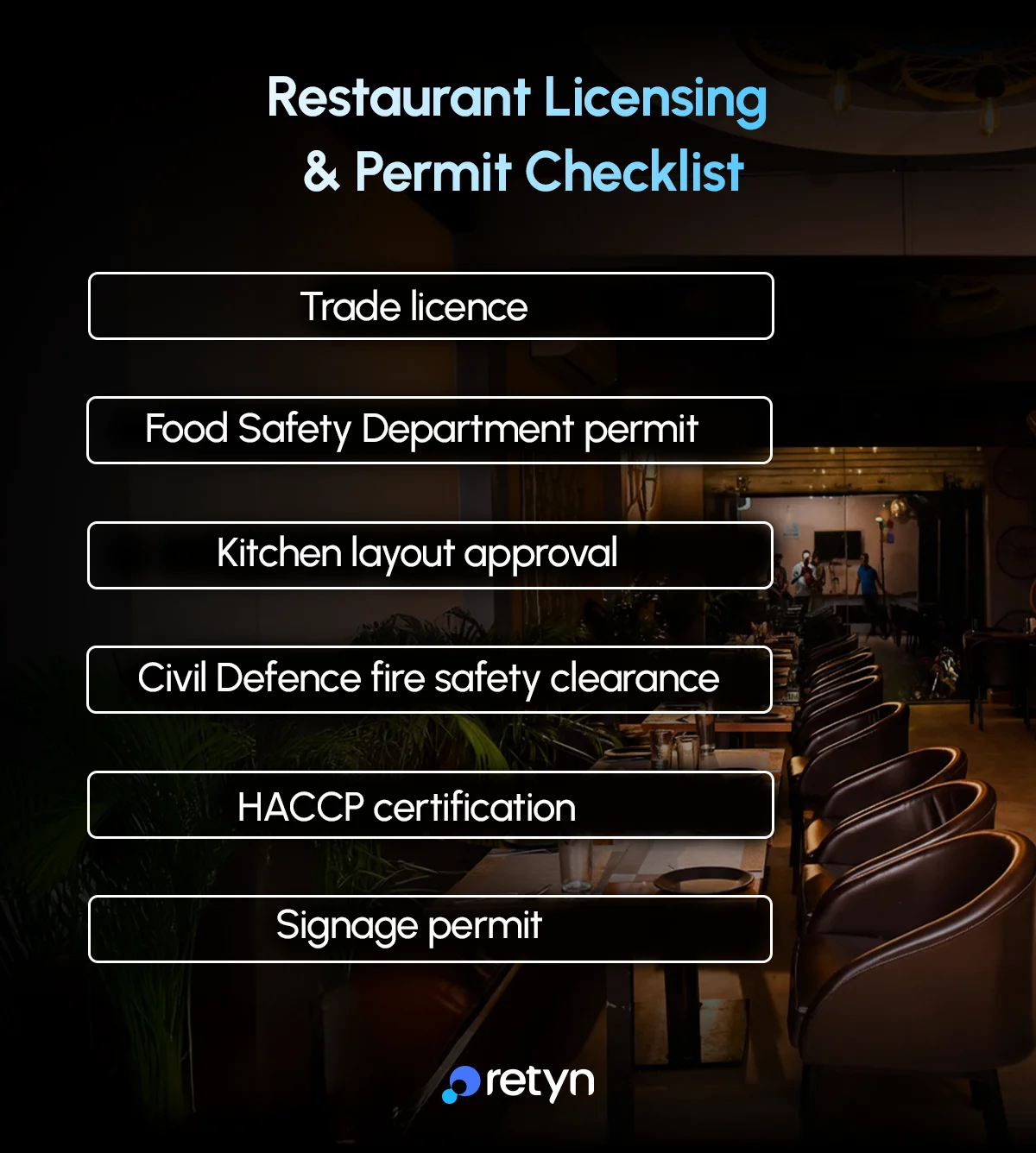
Step 9: Apply for licenses, permits and restaurant-specific approvals
Some additional permits and approvals are needed as given below.
A food establishment permit issued by Dubai Municipality.
Approval of food safety and kitchen design prior to a fit-out of your food business.
A liquor license will be required if you plan to serve alcohol which is subject to strict approvals.
If you have an online delivery service, your food business may be subject to compliance with the requirements of each individual delivery platform you choose to use.
Permits for signage will be required through the local government.
HACCP certification (a food safety program) is mandatory for all food establishments that provide catering services and have large commercial kitchens.
Pro tip
Platforms like Talabat, Deliveroo, Careem, and Noon Food require your food license, Ejari, and trade license before approving your restaurant for onboarding.
Step 10: Consider insurance options for restaurants
Consider the following essential insurance policies.
Public liability insurance (PLI) – Protects against third party injuries.
Product liability – Protects against food poisoning claims from customers.
Property and kitchen equipment insurance – Protects against damage or loss of equipment, building etc.
Workers compensation and staff health insurance – Protects against accidents on premises.
Fire and safety insurance- Mandatory for all landlords.
Free 2025 Restaurant-Compliance Calendar (Excel)
Stay on top of food-safety audits, trade-licence renewals, and Dubai Municipality inspections. Tap below and we’ll WhatsApp the Excel sheet instantly.
Additionally you should be familiar with the primary sources of funding for restaurants in Dubai. Examples of funding options are:
Bank loans – require a business and personal financial history
SME loan or similar facility – require a business and personal financial history
Financing for a Franchise Outlet – can be an option if required as part of franchising agreement
Angel investors – often target cloud kitchen and food-tech start-ups
Venture capital – can be targeted by many cloud kitchen and food-tech start-ups
Supplier credit – can be used to fund certain aspects of your business and provide working capital.
Rental partnerships – can be used to lower initial cost and improve cash flow during the early stages of your business.
“Safeguarding food safety is a cornerstone of enhancing quality of life in the emirate. These achievements reflect the ongoing efforts by Dubai Municipality to build a comprehensive and sustainable food ecosystem that promotes well-being and consumer trust in the quality of food available in our markets.”
- Dr. Sultan Al Taher, Director of Food Safety at Dubai Municipality
Step 12: Keep track of filings, renewals and taxes
Staying current with local laws and regulations is vital to the smooth running of your business within the UAE. These include an annual renewal of your trade license as well as maintaining any mandatory tax registrations and ongoing VAT obligations.
Corporate tax will be applied at 9% to business profits over AED 375,000, or you may qualify for 0% corporate tax benefits, depending on whether your business operates from a free-zone.
You should also:
Submit your UBO and ESR where necessary.
Compile and submit audited financial accounts if needed by your trade licence.
Pay all employee wages via the Wage Protection System (WPS).
Comply with UAE Labour law, regarding employee end-of-service gratuities.
Decision Snapshot (Healthcare)
Priority
Best Fit
Dine-in restaurant or cafe
Mainland LLC (DET)
Delivery-only/cloud kitchen
Free Zone FZ-LLC with food license
Franchise expansion
Branch or Mainland LLC
Catering services
Mainland LLC or Free Zone with HACCP approval
Pro tips for restaurant entrepreneurs in Dubai
Here are some tips you should know on how to start a food business in Dubai.
Prime location spots need landlord approval and food court allocation. So, you must secure your location early.
Get kitchen layout approval before fit-out to avoid redesign costs.
Give staff mandatory training in handling food and hygiene.
Make sure your suppliers are HACCP-certified.
Schedule proper inspections and renewals to avoid heavy fines.
Think ahead: License all activities from the start if you are planning to expand with multiple outlets and catering services in the future.
Selecting an activity code that doesn’t match your menu scope (DET may reject your licence).
Overlooking mandatory Food Code & PIC training—required before opening.
Under-budgeting for grease-trap installation & cleaning fees.
Signing a lease beforePre-Approval from Dubai Municipality Food Safety Dept.
Delaying DEWA load-schedule upgrades—can postpone fit-out by weeks.
Using a PO-box only—DED and banks need a verifiable physical address.
Regulation & News updates · 2025
Dubai launches ‘DM Checked’ digital platform for unified food inspections - 17 Nov 2025:
Dubai Municipality rolls out DM Checked, digital system for food inspections and nutrition monitoring, improving transparency and compliance.
Dubai launches unified ‘City Inspector’ system to streamline inspections - 09 Oct 2025:
Dubai Municipality certifies 63 inspectors, standardising inspections and reducing duplicate visits across food safety and public facilities.
Abu Dhabi restricts out-of-home ads for unhealthy food and drinks - Oct 2025:
Outdoor billboards can only feature SEHHI-grade food and drink products, and every advertisement must receive approval before it goes live.
Dubai issues new guidelines to elevate online food delivery sector - 2 Sept 2025:
New best-practice guidelines released for food delivery platforms, focusing on fair terms, data transparency and competitive sector growth.
Updated sample-quantity rules issued for food testing in Dubai - 09 Jun 2025:
Updated guidelines shares minimum sample quantities, packaging conditions and retesting requirements for food regulatory testing.
Ban on the import, production and trade of single-use plastic products - 5 Jun 2025:
UAE to enforce full ban on the import, production and trade of single-use plastics
Glossary of acronyms
DM - Dubai Municipality
DED - Department of Dubai Economic Development
PIC - Person-In-Charge (food-safety certified)
HACCP - Hazard Analysis & Critical Control Points
FSD - Food Safety Department (DM)
DEWA - Dubai Electricity & Water Authority
CT - Corporate Tax (9 %)
VRP - Vermin & Rodent Proofing
FAQs on restaurant business setup in Dubai
Yes. Every restaurant, cafe, cloud kitchen or catering business must receive approval from Dubai Municipality's Food Safety Department prior to opening. Approval is needed for kitchen layout, fit out, food establishment permit and a final inspection before operations.
Yes, but you must have the appropriate activity license to prepare and deliver food. Cloud kitchens do not provide dining services and they must comply with Dubai Municipality or the relevant free zone authority's food safety, ventilation and layout requirements.
No. The majority of restaurant activities in Dubai allows 100% foreign ownership either through a mainland LLC or through a free zone company. There are however some restricted activities such as serving alcohol that will require additional approvals and may subject to specific regulations.
All restaurants must comply with the Dubai Food Code, which outlines hygiene standards, food storage, temperature control, waste management, pest control, equipment sanitation, and proper staff training. All kitchen staff must be certified in food handling.
Need expert guidance before you get started?
Book a free consultation with our specialists and get personalized advice on licensing, compliance, costs and the best structure for your restaurant business in Dubai.
Disclaimer: This content is for informational purposes only and does not constitute legal
advice. Business setup regulations can change. Always consult with a qualified professional for your
specific needs.